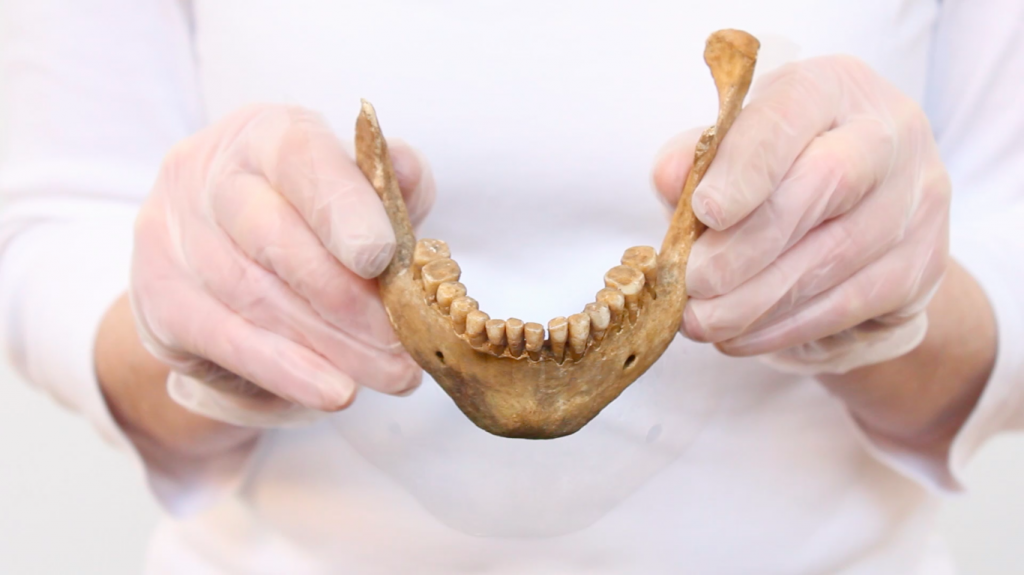
Thread (2014), video still
THREAD
(2014)
Death • Archaeology • Museums • Human remainsThread is a short film made by Robert and archaeologist Lucy Walker with camera work by Deveril. The work explores issues of heritage, after-life and power. Tightly framed shots of a human skull, human jawbone and a cremation urn being handled are accompanied by a spoken text and other sounds - the brush of fingers on bone, pealing church bells, and water.
In 1906 archaeologist Nina Frances Layard excavated an Anglo-Saxon burial ground at Hadleigh Road in Ipswich. The contents of the graves suggested that the site was a Pagan cemetery of the 6th century. It was discovered during a Borough Council employment project to level the ground in anticipation of new housing development, and Layard worked hard in the face of many practical difficulties, to recover and record as many of the burials as possible.
As a woman, Miss Layard was unable to deliver a lecture to The Society of Antiquaries in London, or even be seen to be present when her paper was given to the assembled audience of men. So she stood behind a curtain whilst John Evans gave her paper about her excavations. She went on to publish her findings in the Proceedings of the Suffolk Institute of Archaeology and Natural History for 1909.
The museum 'after-life' of the excavated material is complex and disturbed. In 1918, Miss Layard admitted to Ipswich Antiquarian Society that she did not think local people would want to think their ancestors were Germanic. The material also represents complexities and collisions of time interweaving past, present and future, histories in the earth beneath our feet, changing land use, cultural identities and practices, and loss of collective memory.
Thread emerged from extended discussions between Robert and Lucy, about the process of excavation and the transformation of artefacts or things when curated in a museum; about access and agency, and restrictions on what and how the surviving remains could be handled and photographed.
As a result, Thread reflects the multiple layers of context and meaning embedded within the archaeological material, and also challenges traditional ideas about curation, access, knowledge creation, explanation and interpretation.
SPOKEN TEXT
As narrated by Lucy in Thread
Once upon a time, in a place that used to be here, precisely here, where you and I are right now, there lived an entire community of people, who looked and ate and smelled and loved in exactly the same way we do.
Some were higher up the social ladder. Most were facing challenges. Many had little but gruel to eat for weeks at a time. And some, some wore gold.
As the saying goes, the devil makes work for idle hands, and owing to the fact that much work had to be found for a large number of unemployed, a scheme was devised to dig over the dead.
On:
‘Proceedings of the Institute of Archaeology and Natural History
For the Collection and Publication of Information
On the Ancient Arts and Monuments of the County
Volume 13’
Most were found horizontal, arms close by their side.
Small remnants of garments preserved by rust.
Rough pots that once held food. Others, human remains.
No easy task to find and exhume, as they lay in damp earth for all time.
A systematic examination was then made of every grave as it was found, with the result that treasures have been unearthed, dug up, and cleaned, and tagged, and logged, and recorded, and conserved, and stored, and considered, and displayed, and displaced, and devalued, and discussed, and debated, and detached, and abducted, and distorted, and elevated, and studied. And cared for.
Grave 5, Fragments and amber glass drinking cups
Grave 9, Feet to North East
Grave 11, Small knife, gold buckle
Grave 14, Feet to North East
Grave 19, Garnets and shell or ivory, chin bone covered with verdigris from the fibula placed below it, small double-toothed comb on left of skull, small iron ring with pendants, large iron pot-hook
Grave 24, Necklace of 11 beads, one crystal
Grave 25, Found whilst I was ill
Grave 34, Urn only, in fragments
Grave 46, Feet to North East
Grave 52, Iron fittings of bucket, ring and knife, square headed brooch, necklace of 88 beads, 32 coloured, 52 amber
Grave 58, Skull, spearhead, shield boss, knife, strike-a-light, handle of boss with canvas.
Grave 148, Skeleton gone to pieces, pot hook still attached to iron ring at waist; broken knife
Grave 154, Below chin necklace of 30 beads, 3 twisted wire rings, small iron buckle at waist; feet to north-east…
CONTEXTS
Thread was created as part of Performing Collections, a strand of Pacitti Company Think Tank activity running from 2013 to 2016, made with the support of Ipswich Museum. An investigation into memory and place, Performing Collections researched and developed ways of looking at museum collections from multiple perspectives. Or, as Lucy Walker described it, ‘exploring how we might engage with the remains of past lives.’
What is heritage? How can artists, thinkers and other members of the community engage with museum collections to explore contemporary issues? And how might that be meaningful to the many varied people of a town like Ipswich?
In March 2014, Pacitti Company hosted the Performing Collections Symposium at the Think Tank, publicly exploring these questions. Thread was created for this event.
Later in 2014, Thread was discussed in the Think Tank Workbook, edited by Robert, Lucy, and Deveril, each of whom also contributed chapters further exploring the themes of the film.
In 2016, Thread was curated by artist Lisa Temple Cox as part of Art:Science:Life, a three month exhibition celebrating Ipswich Museum's long relationship with both the arts and science. The looped film was shown on a gallery monitor, along with an archival case set behind a curtain, holding a first edition of the publication which Miss Layard’s materials were finally written up in.
Also in 2016, as part of the Art:Science:Life exhibition events programme, Robert and Lucy created a public presentation titled Unravelling Thread, a performed exchange of emails sent between them raised a variety of issues relating to geology and landscape, human impact, time, long time, decay and regeneration; and curatorial issues to do with who owns the past, what we do with it, and how we may use those remains today.
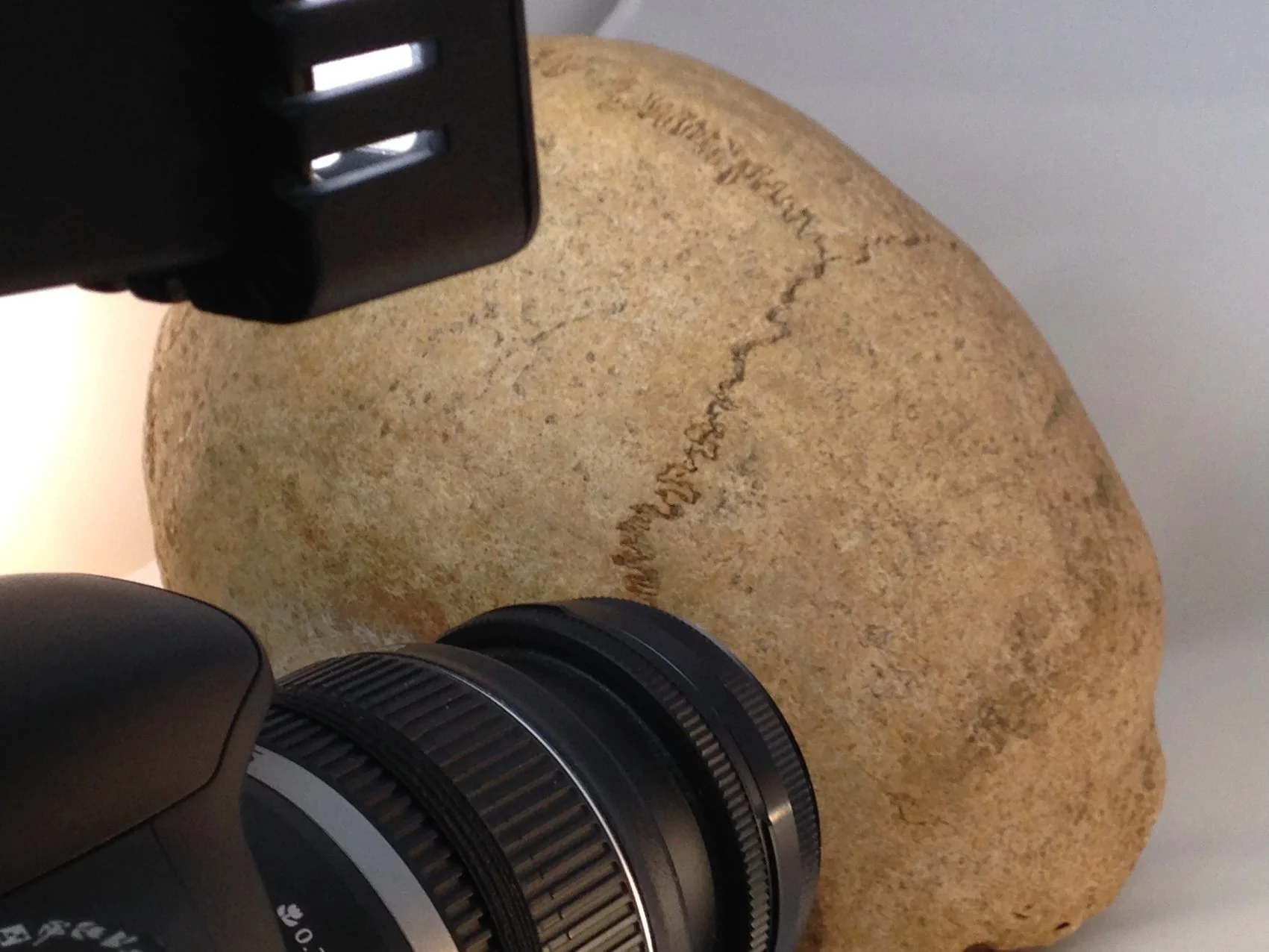
Making Thread (2014), human skull, loaned by Ipswich Museum
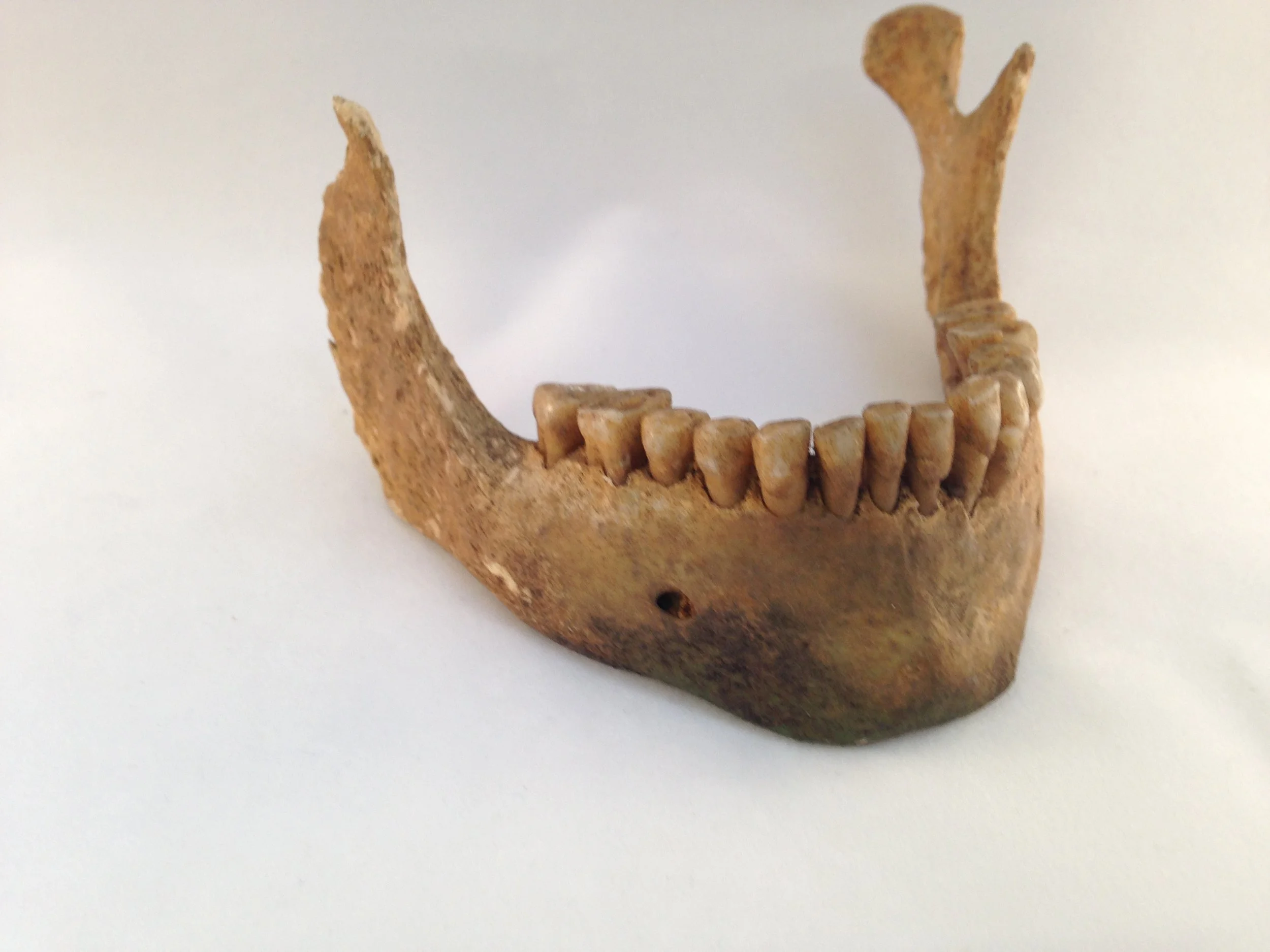
Making Thread (2014), human jaw, loaned by Ipswich Museum
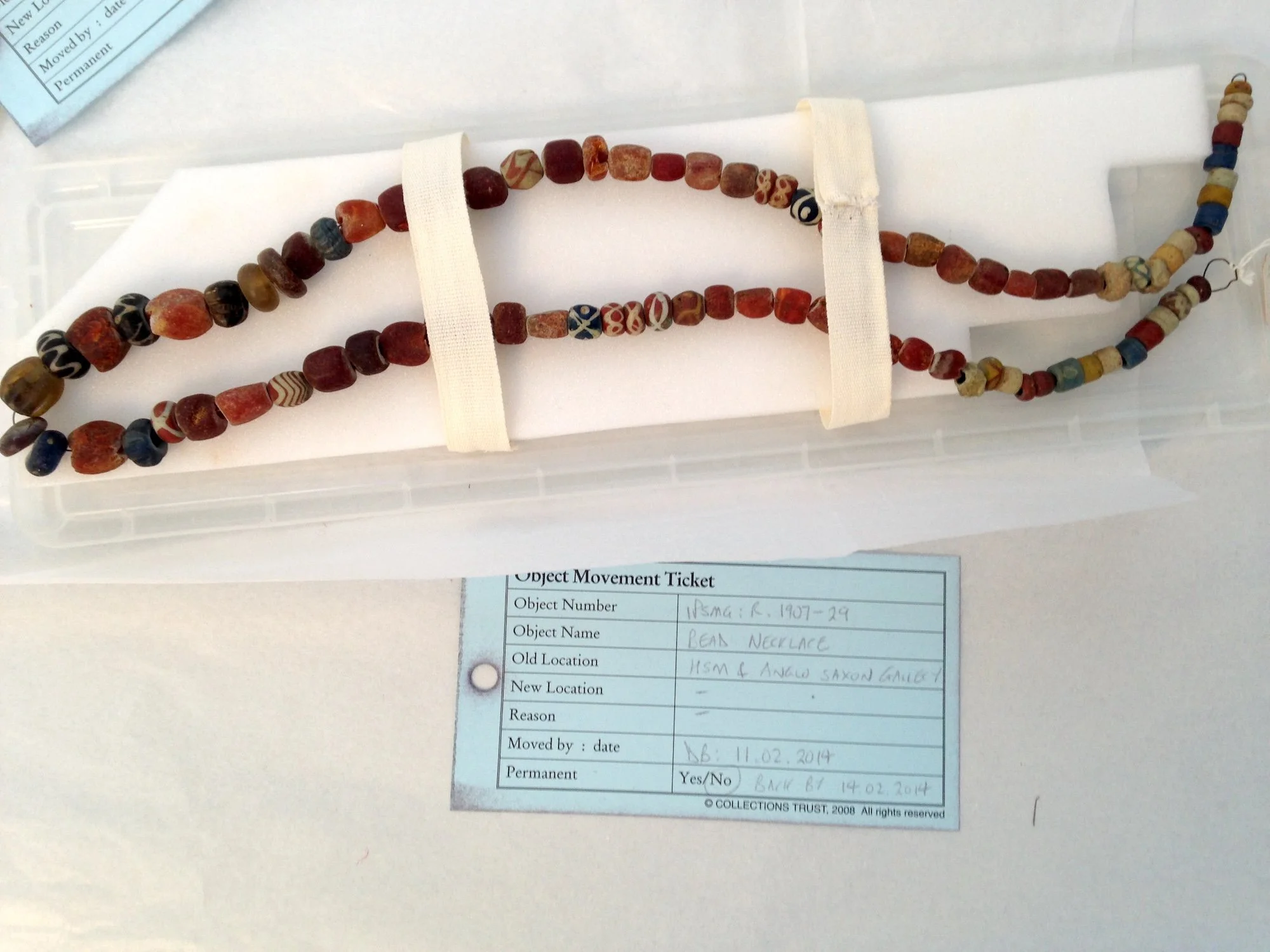
Making Thread (2014), Anglo-Saxon beads excavated by Nina Layard in 1906, loaned by Ipswich Museum
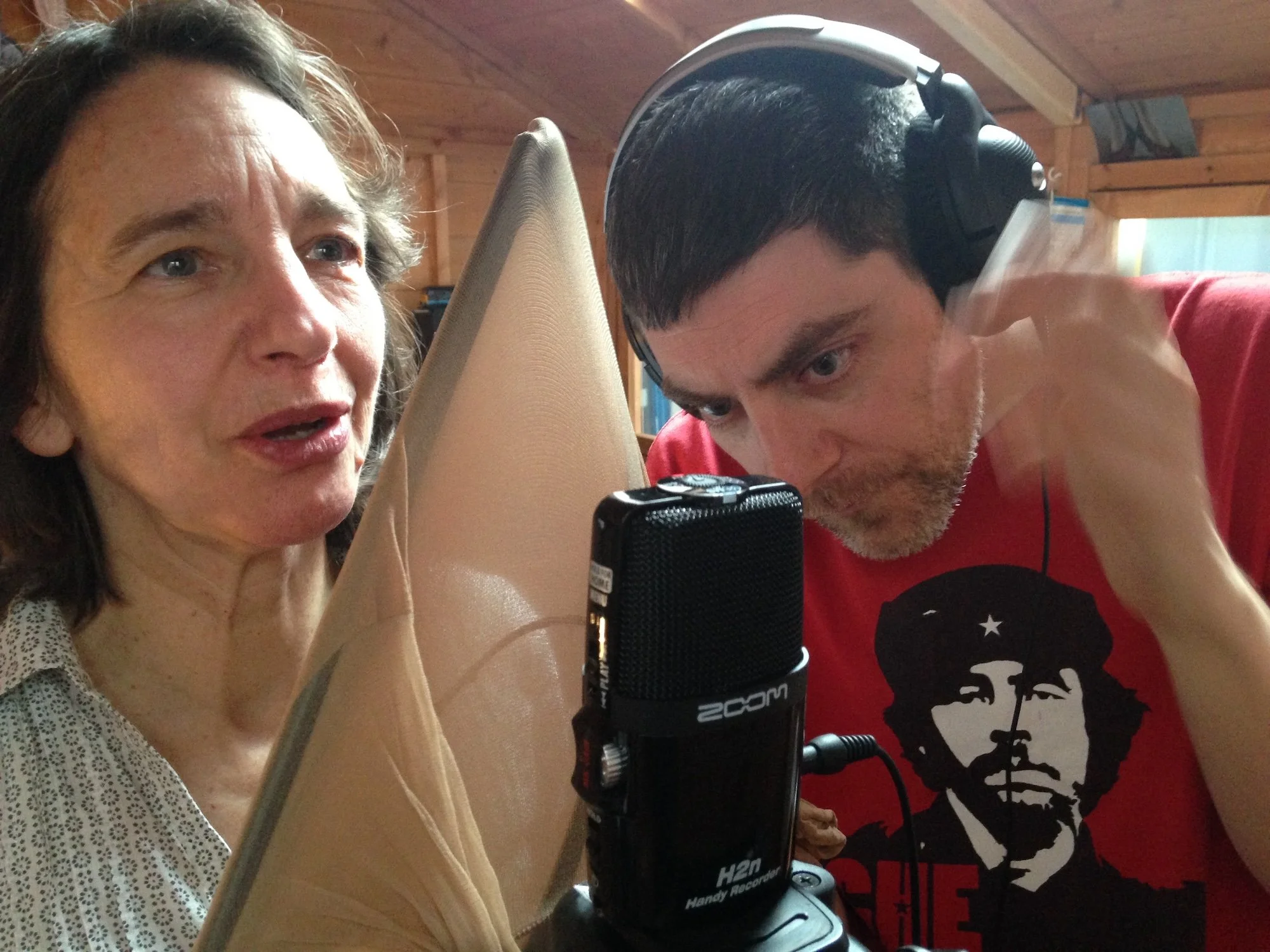
Lucy Walker and Deveril recording the spoken text of Thread (2014)
DOCUMENTS
Unravelling Thread - Session Notes from a talk by Lucy and Robert
Think Tank Workbook - The full script written for Thread, page 140
CREDITS
Date: March 2014
Duration: 2’38”
Premiere: Performing Collections Symposium, Think Tank, Ipswich
Concept, research and writing: Lucy Walker and Robert Pacitti
Performer, narrator: Lucy Walker
Direction, storyboard, foley: Robert Pacitti
Camera, vocal recording, transfer: Deveril
Editing, soundtrack: Deveril and Robert Pacitti
Producer: Pacitti Company
Context: Part of Performing Collections - a Pacitti Company Think Tank research strand, funded by Colchester & Ipswich Museums as part of Unlocked.
Special thanks to: Jayne Austin, Bob Entwistle, Will Heppa, Joan Lyall, Rachel McFarlane, Bill Seaman, Darren Stevens, Marie Taylor-Stent, Saskia Taylor-Stent, Lisa Temple-Cox, Graham Webber, Philip Wise.