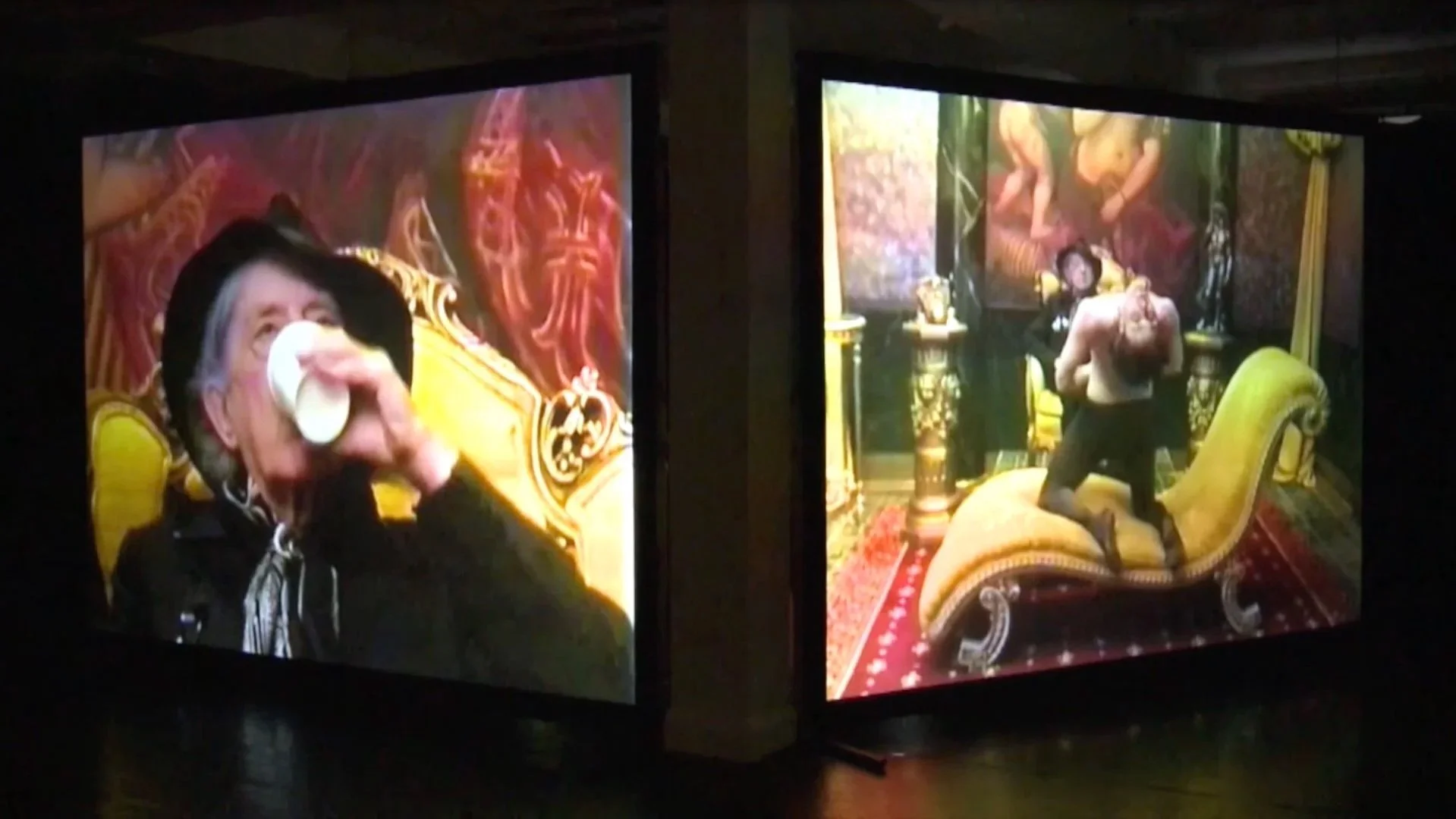
The Waiting Room (2015) by George Stamos. Still from video documentation by Ana de Matos.
LA SALLE D’ATTENTE
(2015)
Installation • Heritage • Intergenerational • DialogueLa Salle D’Attente is a four-screen video installation by Robert Pacitti and Canadian artist George Stamos. Formed of two separate film documents, each recording one artist’s encounter with Quentin Crisp, the work brings their footage together in dialogue.
Quentin first came to attention in 1968 when his autobiography The Naked Civil Servant was published. He died in 1999, author of 14 books and star of over 20 films.
In 1996, Pacitti travelled to New York to meet and spend time with Quentin, later writing of him, “I have seen the face of a parent”. Civil Extracts isolates a section of film footage from that time and presents it anew as a loop. In The Waiting Room, George Stamos appears nude, watched by Quentin in footage from 1997, as a reference to his former self as an art-fag gogo boy, and to Crisp’s years of experience as a nude model for art classes.
Montréal-based George Stamos is a choreographer, dancer and educator. In his formative years, Stamos was a gogo dancer in Toronto, London, Amsterdam and NYC, and he is a 1993 graduate of The Amsterdam School of the Arts.
NOTES ON CIVIL EXTRACTS
By Robert Pacitti
October 2015
‘I was born in 1967 – the year that homosexuality was conditionally decriminalised in Britain – the same year Nico sang Chelsea Girls – the same year The Naked Civil Servant was first published. I am the bastard twin of these events – “we are family”.
In 1995, I travelled to New York to meet and spend time with the author, raconteur and professional homosexual Quentin Crisp. My aim was to produce a new performance work that took Crisp's infamous autobiography The Naked Civil Servant as its' starting point. Wishing to explore issues around disobedience and liberty I saw Quentin as a forerunner to many of the then queer / post-gay identities of the day. Crisp had always run the gauntlet of public disapproval and at the time of our meeting I wrote of him ‘I have seen the face of a parent’.
Civil premiered in 1996 and I went on to perform it around the world for the next few years. At Quentin’s memorial in 1999 I performed some of the material - literally under his trademark hat - and knew I no longer wished to embody Civil again. How could I without it now being a work about loss? But I knew it still held social and political significance, so I carefully remade it, built around the heart, body and mind of another performer. Civil then continued to tour worldwide, with Richard Eton performing it brilliantly, until 2009.
Undeniably the emphasis of Civil has now shifted and a work that initially set out to explore shared aspirations and joint activism now reads as a series of images and ideas placed in relation to notions of legacy. Also whilst Civil is not a museum piece aspects of it are more common place onstage than when it was made and elements of the live performance are now undeniably dated. But the spirit of that work, and the time I spent with Quentin, remains one of activism and the power of the individual to create change.
The footage shown within La Salle D’Attente is a section of film shot by Charlie Pulford, of Quentin and I walking around New York’s East Village in 1995. I am 28 and he is 88. The three of us had been for lunch at Quentin’s favourite diner – “grilled cheese, tinned peaches, hold the cream” – and were on our way to his small apartment on East 5th to talk. It was the last time we saw him alive.’
NOTES ON THE WAITING ROOM
By George Stamos
October 2015
‘The Waiting Room is a reframing of a meeting I had with Quentin Crisp in 1997 at The Versailles Room of Pandora’s Box, a private S&M service provider in NYC. This meeting was connected to research I was doing for my first group piece Red Light Roosters. My research at the time was oriented towards examining intergenerational relations between men who have sex with men and increasing the visibility of elderly gay men.
When I asked Quentin, then 88, if he’d like to perform in Red Light Roosters he said he couldn’t guarantee he would be alive or able to climb the stairs of the theater on opening night, so perhaps we should video a meeting instead. In retrospect, at that point this video became a project in it’s own right, one which has taken nearly 20 years to manifest as The Waiting Room.
In 2010, I met Robert Pacitti in Montreal and we discussed our varying works referencing Quentin. La Salle D’Attente is a natural pairing for obvious reasons and is also the outcome of a dialogue we have maintained for the past 5 years. In 2014 I envisioned the potential for a video installation comprised solely of portions of the original footage.
The title The Waiting Room seems appropriate for this piece that has taken so long to process. I decided to highlight the non-verbal dialogue between Quentin and I in our meeting with this work. Looking back at his patient gestures in cohabitation with my offering of a casual sexuality revealed to me a story of aging (my own and in general) and the importance of preserving intergenerational queer transfers. Nearly 20 years later I appreciate more fully how Quentin's power existed not only in his witty tongue and personal appearance but also in his patience, grace and persistent imagination. The Waiting Room is a tribute to Quentin, a remembrance of my former self and a dispelling of shame.’
IN CONVERSATION
To accompany showings of La Salle D’Attente at Toynbee Studios in London, In Conversation saw George and Robert chatting about their respective works and experiences of knowing Quentin. This evoked tales from the Lower East Side, further explored why Stamos and Pacitti were drawn to Crisp as an influential cultural figure, and was followed by an audience Q&A.

Civil Extracts (2015). Still from documentation by Ana de Matos.
The Waiting Room (2015) by George Stamos. Still from documentation by Ana de Matos.
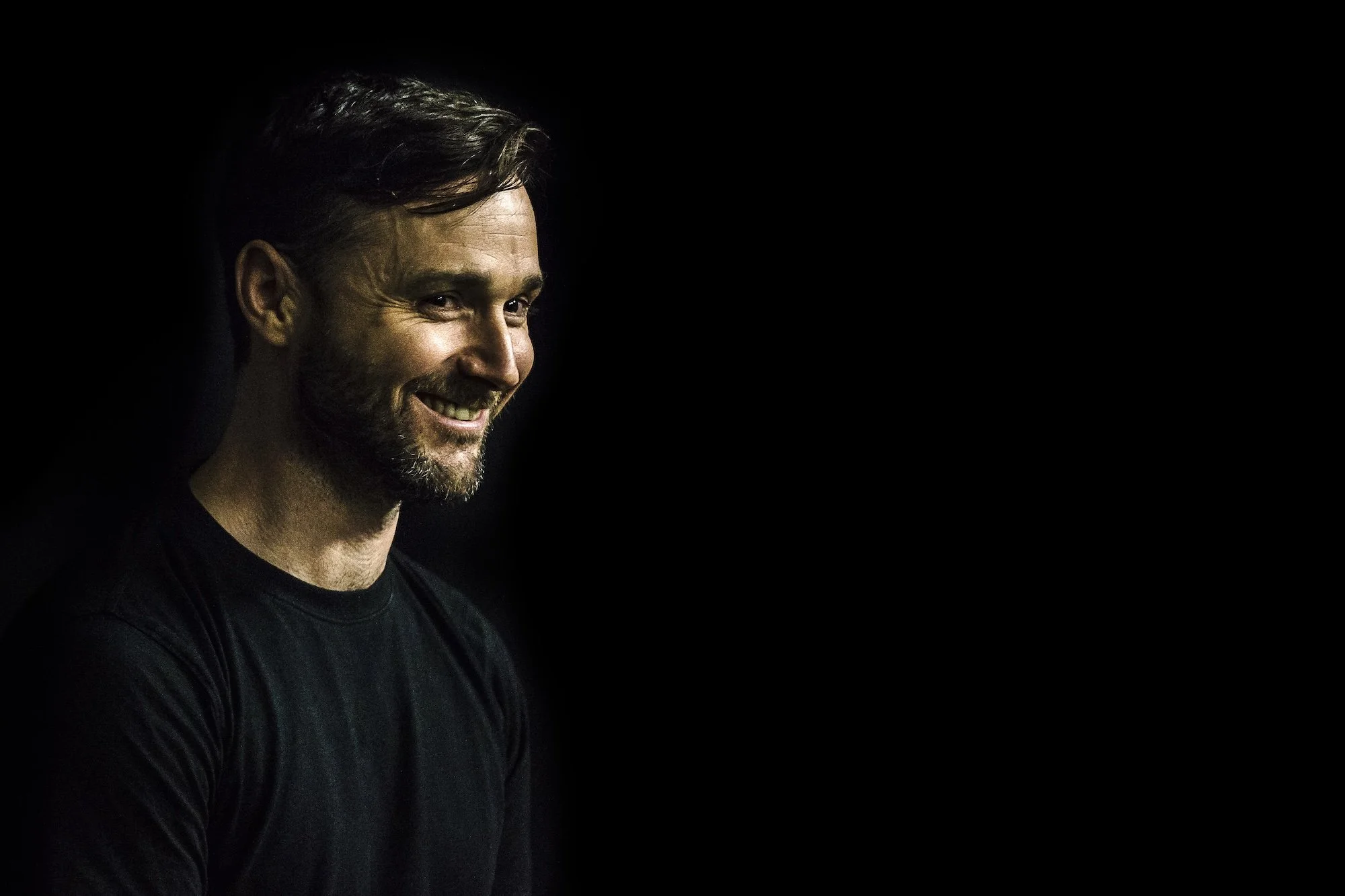
George Stamos, In Conversation (2015). Photo by Guido Mencari.
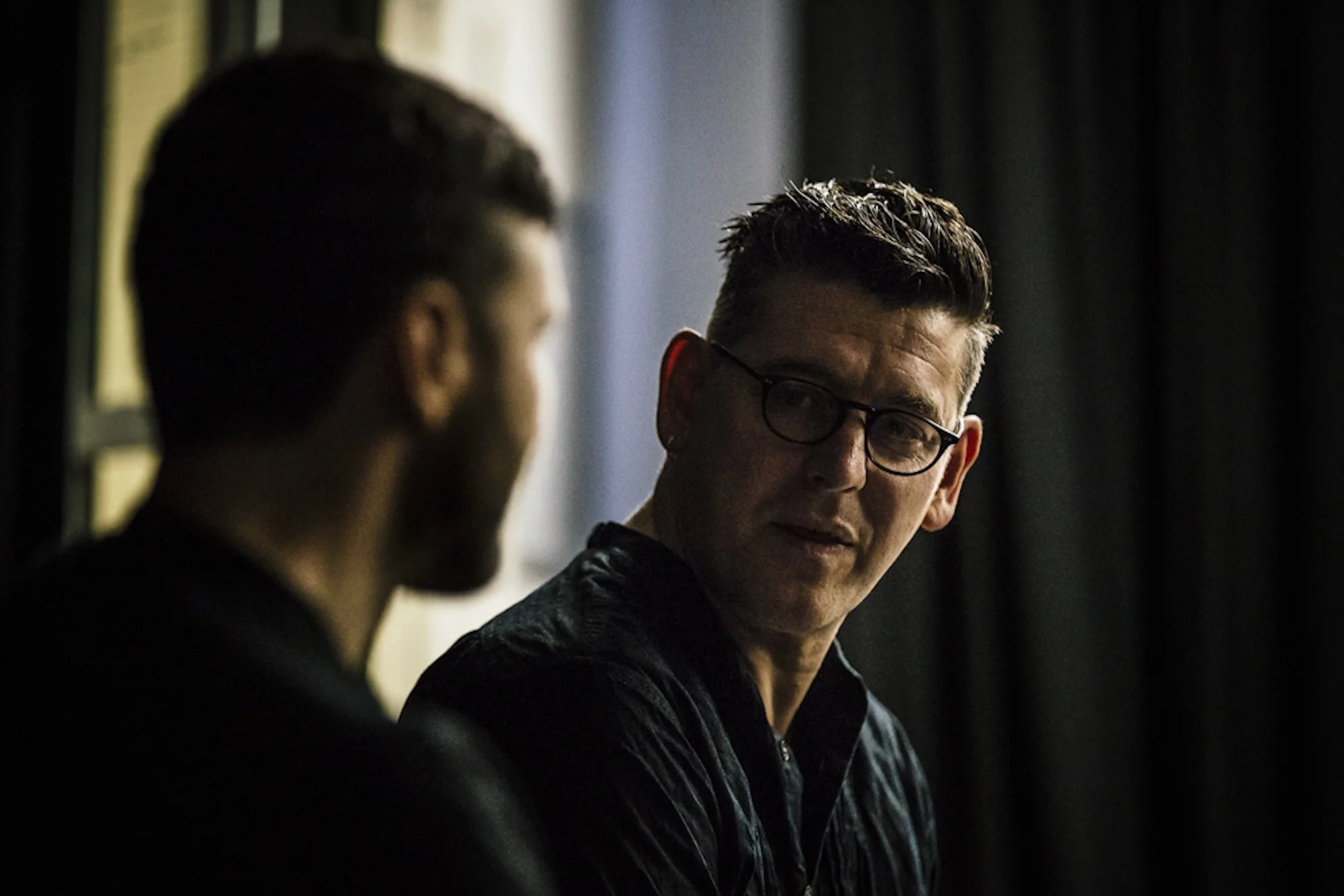
George Stamos and Robert Pacitti, In Conversation (2015). Photo by Guido Mencari.
CREDITS
Premiere: 5 - 7 November 2015
Duration: Looped video
Place: Toynbee Studios, London
Concept, direction: George Stamos & Robert Pacitti
Original 1995 camera work: Charlie Pulford (Civil Extracts)
Original 1997 camera work: Maria Beatty (The Waiting Room)
Video synch: Robert Prouse
Technical support: Simon MacColl
Sound: Chelsea Girls performed by Nico, written by Lou Reed and Sterling Morrison, published by Polydor / Polygram / Universal, used under license.
Funding: Pacitti Company core funding.
Special thanks to: Gary Varro and Performatorium Festival, Brendan Healy and Buddies in Bad Times Theater.