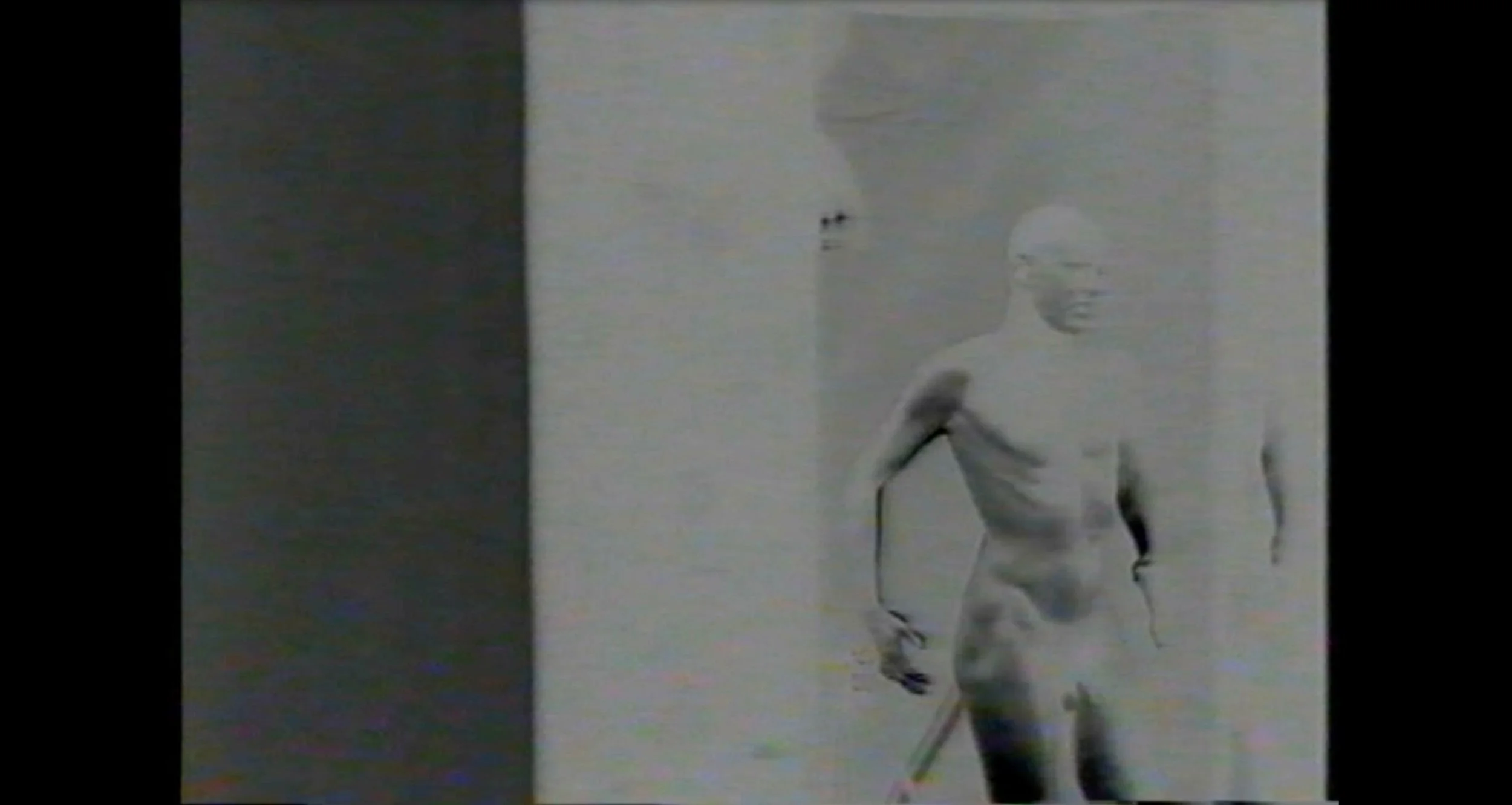
Self-Elimination (1998). Self portrait on video.
SELF-ELIMINATION
(1998)
Solo performance • Death and dying • Installation • ResearchSelf-elimination was a process-based work presented in two distinct parts. The first phase was a live performance and installation at The Green Room in Manchester (June 1998). The second phase, Self-elimination (Flirt), took place that September and featured a large-scale outdoor projection of Robert’s eye. It was displayed nightly for two weeks on the temporary hoardings of the Arndale Centre, following the IRA bombing of Manchester.
For the live performance, Robert posed a central question: supposing you had an hour left to live, could you honestly say that whatever actions you undertook - however large or small - you were completely and utterly committed to them? For an hour... just supposing.
The work consisted of a sequence of primarily private actions performed in front of an audience. By constructing visual, verbal, and aural ‘shrines’, the piece explored what it truly means to be present.
In the months leading up to the performance, Robert researched and created material within the Hunterian Museum and the Pathology and Anatomy departments of the Royal College of Surgeons in London. Drawing on that material, Self-elimination bridged the gap between our fragile mortality and the analogue and digital processes used to document it.
Both phases of Self-elimination belonged to a larger, interdisciplinary body of work titled Evidence Of Life After Death (1999), an attempt to evaluate contemporary attitudes towards death and dying, in both cellular and social terms.
REFLECTIONS ON SELF-ELIMINATION, PHASE 1
In this extract from his developing memoir, Abracadabra, Robert writes about making this work:
‘I am approached by presenters Helen Cole and Tamsin Drury, who operate as hÅb in Manchester, about making work for them… I explain that I want to make a large future work (Evidence of Life After Death) exploring death and dying, but in order to do that I feel I somehow need to mark a symbolic performative death, or series of deaths, first. Self-elimination will allow me to do that and represent some sense of ‘passing’.
The first phase is a one-off live multi-media performance simply titled Self-elimination. It shows at the Green Room in Manchester and is followed the next day by an installation of ‘what’s left’ in the same performance space. Whilst ostensibly a solo live performance two other people, Richard Barnes (also known as Richard / Dicky Eton) and a woman called Sarah Jane are present on and around the stage area in order to assist with the construction of some of the larger images within the work. Sarah Jane I know from us both being out and about on the queer scene, whilst Dicky is someone I taught when he was a student at Arden College in Manchester and I was a visiting lecturer.
The starting point for the performance is a question: what are the implications of genuinely acknowledging our own mortalities? And, as we are all undeniably already committed to our own deaths, as a biological and social fact, how can we respond to this knowledge in an emotionally efficient, and yet generous, way?
I decide to make the show exactly one hour long in order to set up a challenge - if we found out we had just one hour left to live, could we fully commit to the activities of that final hour, however mundane they might be, with absolute conviction? This is the performative task I set myself.
-
At the beginning of the performance a computer generated digital clock is projected onto the floor of the stage and proceeds to count down 60 minutes, second by second, until inevitably the time runs out.
On stage I am seen creating shrines, ritual assessments of my life and desires. Some of these altars are literal, visual constructions. Some are made with language and sound. Some are documentation from previous events and times within my past, and indeed that of my family.
Across this hour I step in and out of projected slides showing members of my family and other loved ones, Sarah Jane and Richard lay out a large pile of shoes into lines that fill the stage, I dance carefully with candles on my shoulders and perform an unstable strip wearing my chicken mask and high heeled shoes, wobbly, afraid perhaps. I carefully trace the contours of my body with UV lights, revealing a detailed illustration of my internal organs which, invisible until now, was drawn onto my flesh before the work started. I sing. I speak. I dance. I wait. Until eventually, knowingly, as the last few seconds count down in red flashing digital projection, I slip out of sight and into darkness as the lights fade to blackout.
This is an intense live work. During the performance, and at its end, I’m very moved. But there are also people crying in the auditorium and some of them don’t move to leave. Whilst this was not my intention I have to recognise that in some ways I have deliberately set out to manipulate this space, emotionally, through music, text, projections and actions. In some ways this was always the point, so that what will come next can interrogate the cool reality of what happens as and after a body passes.
-
On the day following the performance the Green Room theatre space is opened up to the public to come and view the relics of my ‘life and recent death’. For the purposes of tightening up this installation I take a little bit of artistic licence and reconfigure the order in which some of the images occur, so that more aspects of the work are actively apparent when entering the space. Outside of this tinkering however, the site exists as a residual illustration of recent action.
The first phase of Self-elimination charted some extremely private territory. Not only did it explore what it means to take on the realisation of my own death and that of those around me, it also lay bare images from my family as far back as my grandparents wedding day with my great grandparents in attendance. And none of those people are here anymore.’
No photographs from this performance are currently available. Video documentation and marketing exists for this project and will become accessible, in due course, as part of the Robert Pacitti Archive held by the Theatre Collection, University of Bristol.
CREDITS
Date: 18 June 1998
Place: The Green Room, Manchester
Duration: 60 minutes
Written, created, performed: Robert Pacitti
Onstage support: Richard Eton, Sarah-Jane
Digital countdown clock: Matt Mawford and Graham Clayton Chance
Venue technician: Steve Curtis
Produced by: hÅb
Context: Presented as part of Digital Summer ‘98
Thanks to: The Green Room, hÅb, Helen Cole, Hunterian Museum, Roger Nelson, Royal College Of Surgeons, Steve Curtis, Tamsin Drury.