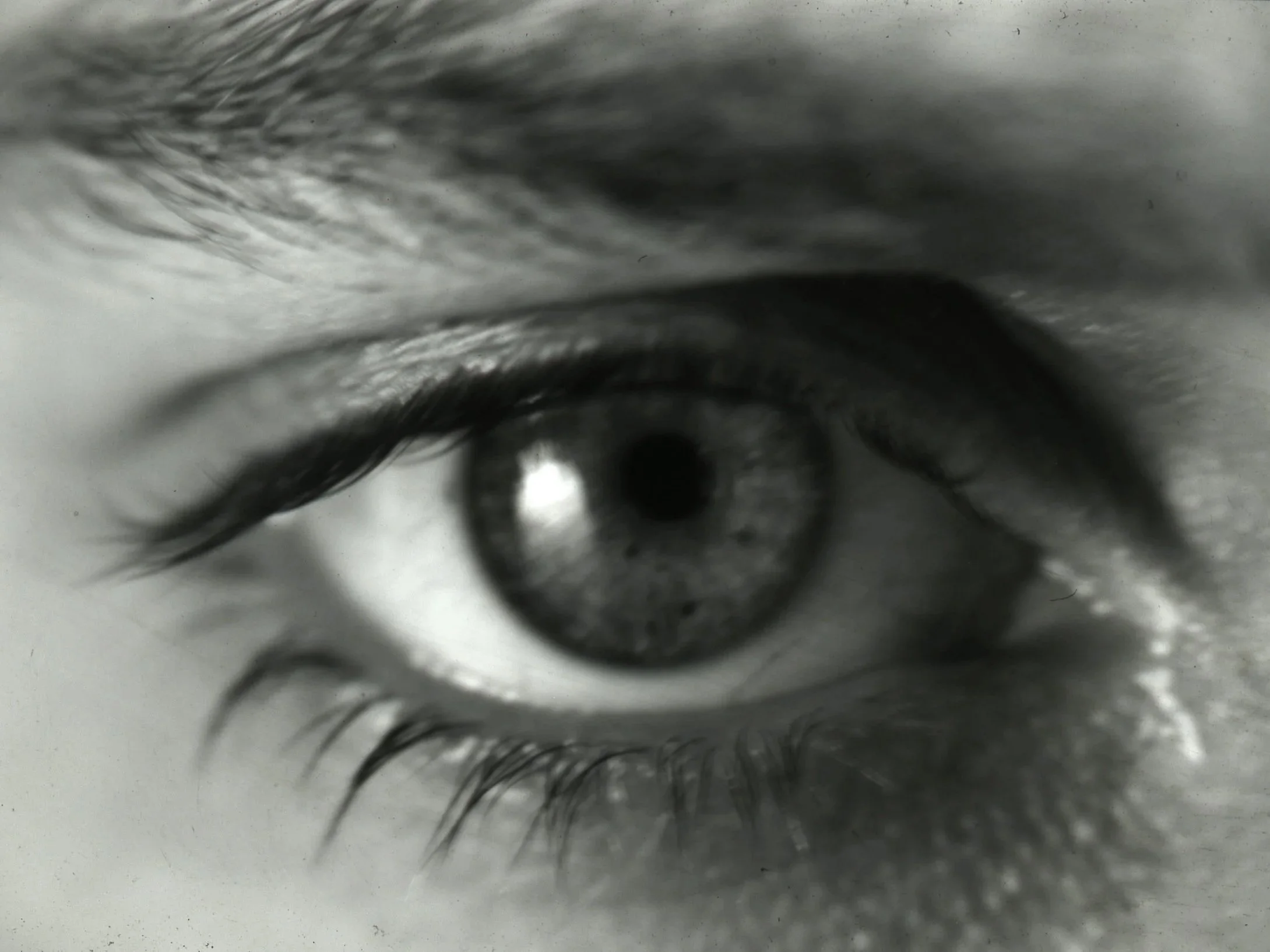
Self-elimination (Flirt) (1998), video still
SELF-ELIMINATION (FLIRT)
(1998)
Outdoors • Projection • Digital Art • ManchesterSelf-Elimination was a process-based work in shown in two distinct parts: the first phase was a live performance and residual installation presented at the Greenroom in Manchester in June 1998. The second phase, Self-Elimination (Flirt) was a large-scale outdoor projection of Robert’s eye, presented in September of that year and shown nightly for two weeks on the temporary hoardings of the Arndale Centre, Manchester, after it was bombed by the IRA.
Both pieces were part of an ongoing body of work entitled Evidence Of Life After Death (1999), an interdisciplinary attempt to evaluate contemporary attitudes towards death and dying. Research spanning two years explored mortality in both cellular and social terms, and included regular visits to the museums of Pathology and Anatomy at the Royal College Of Surgeons in London, as well as a trip to visit modern day mummies in a mountain cave in Mexico.
REFLECTIONS ON FLIRT
In his memoir, Abracadabra, Robert writes about making this work:
‘At 11:17 on the morning of Saturday the 15th of June 1996, an abandoned truck packed with 3,300 lb. of Semtex and combustible fertiliser detonates, blowing up the Arndale Shopping Centre in the middle of Manchester. It proves to be the largest bomb ever exploded in peacetime Britain, affecting over 1,200 properties spanning 43 surrounding streets. Miraculously, no one is killed. Police have already moved 80,000 people away from the area, following a coded tip off given to a local radio station 90 minutes before the explosion. But 212 people are injured and mass panic about casualties takes time to settle, not least because mannequins blown from shop window displays now lay strewn about the streets in a macabre simulation of what might have just been.
Roger and I are away staying in Shrewsbury for the weekend when news of the explosion breaks. Hurriedly packing up the car we drive back to his home in Manchester as quickly as we can, concerned that loved ones and friends might be casualties. It is a frightening few hours, not knowing what it will be like when we arrive, but feeling we have to be there. As it gradually becomes clear that no one has died panic gives way to shock at the scale of the blast. How could something so destructive have happened here, on a packed Saturday morning, at the very heart of this predominantly working class shopping centre in a left-leaning Northern city? What can possibly be gained?
Five days after the blast, the Provisional IRA issue a statement from Dublin claiming responsibility but regretting causing injury to civilians. In time, the remains of the Arndale Centre become wrapped in blue plastic sheeting and rebuilding Manchester begins. And in a couple of years this protective surface will become the canvas for my first large-scale outdoor artwork. But we don’t know that yet.
—
I am approached by presenters Helen Cole and Tamsin Drury, who operate as hÅb in Manchester, about making work for them. The context is a programme of events called Digital Summer, which in turn is part of ISEA - something academic and international to do with electronic arts… I really like Tamsin and Helen, who used to be the administrator of a company I had worked for some years back, so we agree to cook something up. What transpires is a thematic work in two parts, called Self-Elimination. I explain that I want to make a large future work exploring death and dying, but in order to do that I feel I somehow need to mark a symbolic performative death, or series of deaths, first. Self-elimination will allow me to do that and represent some sense of ‘passing’.
The first phase is a one-off live multi-media performance simply titled Self-Elimination. It shows at the Green Room in Manchester and is followed the next day by an installation of ‘what’s left’ in the same performance space. Whilst ostensibly a solo live performance two other people, Richard Barnes (also known as Richard Eton, or Dicky Eton) and a woman called Sarah Jane are present on and around the stage area in order to assist with the construction of some of the larger images within the work. Sarah Jane I know from us both being out and about on the queer scene, whilst Dicky is someone I taught when he was a student at Arden College in Manchester and I was a visiting lecturer.
The starting point for the performance is a question: what are the implications of genuinely acknowledging our own mortalities? And, as we are all undeniably already committed to our own deaths, as a biological and social fact, how can we respond to this knowledge in an emotionally efficient, and yet generous, way?
I decide to make the show exactly one hour long in order to set up a challenge - if we found out we had just one hour left to live, could we fully commit to the activities of that final hour, however mundane they might be, with absolute conviction? This is the performative task I set myself.
—
Phase two of Self-Elimination is titled Flirt. hÅb invite me to contribute to Virtual Billboards, with a brief being to create an image that will be viewed at a temporary site in Manchester city centre every evening for two weeks. Given that phase one of the project had occurred as a one-off live event the extended opportunity that Virtual Billboards offers seems like a good contrast. I’m also very interested in working at scale and outdoors for the first time.
The first phase of Self-Elimination charted some extremely private territory. Not only did it explore what it means to take on the realisation of my own death and that of those around me, it also lay bare images from my family as far back as my grandparents wedding day with my great grandparents in attendance. None of those people are here anymore. So for phase two I decide to deliberately investigate the play between private, public, and the space in between: the half told story, the half glimpsed image.
Creating a large scale image gets me thinking about proportion alongside public / private considerations and I finally decide upon a giant projection of my eye. I love the idea of presenting such a vulnerable part of myself, at night in a city, in close up. I think of the eye as being a witness, watching people as they pass through the Manchester evening streets on their way to somewhere or nowhere, going about their lives. I like the interplay between seeing and being seen, whilst I am not even present, back in London just getting on with other stuff.
With the help of artist filmmaker Graham Clayton-Chance we shoot a durational image of my eye and loop it into a three hour sequence. The site I choose for the projection is a large expanse of corrugated iron being used as cladding over the bombed Arndale Shopping Centre right in the city centre. Not only does the use of this surface raise a range of interesting concerns around the presence of a watchful eye in the evening landscape, it also underscores the temporary nature of the project - the cladding itself is only a semi-permanent skin covering a process of renovation.
—
The evening of the private view (as private as is possible with a brightly lit 40 foot long by 30 foot high blinking eye) I travel to Manchester to help install the image, projected from a room at the very top of the Royal Exchange Theatre building onto the side of the Arndale. Hours later, after the work successfully launches and having gone away for a drink with Roger, we return by car to see the image again. As we drive by, a group of seemingly very drunk men are jumping around in the road, waving at the eye and showing various bits of their bodies to it. Whilst I’m under no illusion they’d probably stand no truck with my motives for making the work, I think it’s brilliant that here they are engaging on their own terms in public space, with something so personal to me yet now disembodied. As if my whole self has been pulled away and all that is left is this one soft part.’
No known documentation exists of this work. If you hold any, please get in touch.
CREDITS
Date: 2 - 12 September, 1998
Duration: 30 minutes, looped
Place: Arndale Centre temporary hoarding, Manchester
Concept and direction: Robert Pacitti
Camera and edit: Graham Clayton-Chance
Producer: hÅb
Context: Flirt was presented as part of ISEA (International Symposium on Electronic Arts) as part of Virtual Billboards, funded by Digital Summer ‘98 and Manchester City Council.
Thanks to: Graham Clayton-Chance, The Green Room, hAb, Helen Cole, Hunterian Museum, Manchester City Council, Matt Mawford, Roger Nelson, Royal College Of Surgeons, Royal Exchange Theatre, Tamsin Drury.