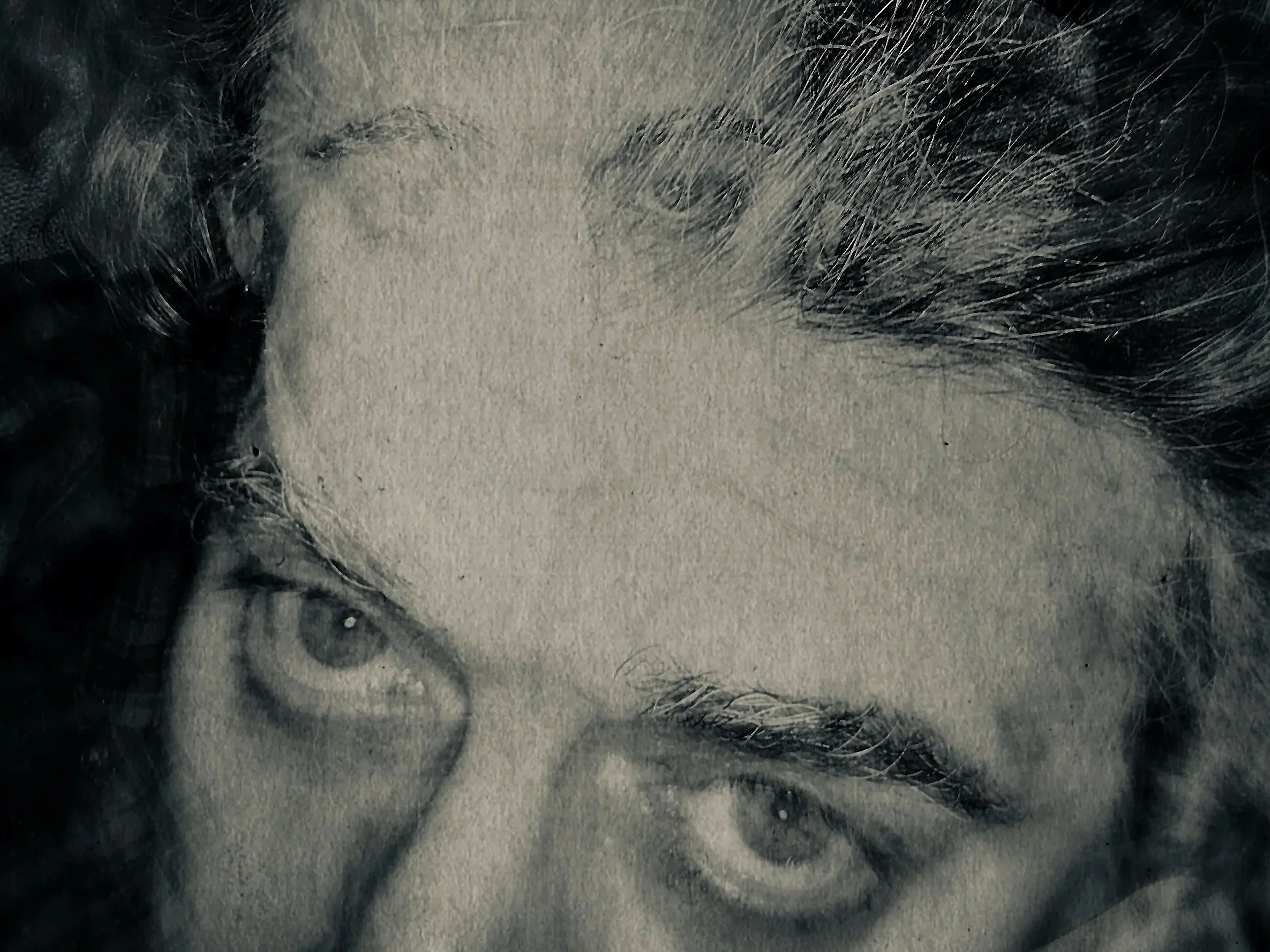
Self portrait(s) (2022)
TEXT
For three decades, the work of Robert Pacitti and Pacitti Company inspired audiences around the world. Often foregrounding sex and death as central themes, the path from soft lad to post-punk experimenter to creator of the SPILL Festival of Performance was bold, determined, and foolhardy. Currently in development, Abracadabra is Robert’s own telling of the journey.
ABRACADABRA
by Robert Pacitti
CHAPTER ONE
(extract)
It’s the 1970s, Ipswich, a time of high unemployment, strikes and power cuts. I live near a heath and spend lots of time there, hiding inside gorse bushes and playing with my penknife. Me and my friend Hazel pretend the helicopters are coming for us – we lay flat on our fronts with our hands behind our heads. There are a number of US airbases strategically placed around the east of England, so the low flying helicopters and giant B52 bombers thundering above us are real. The sound they make as they pass overhead is terrifying and exhilarating – nothing else exists in these suspended moments of extreme noise. We feast on wild blackberries and get sore tummies. We run and we jump – we believe all children can fly. We also fall down, occasionally requiring stitches. All around us the adult world is collapsing. At home we have periods of limited light and heating. Sometimes Mum takes me out for a walk to avoid the milkman or the veg man, as she doesn’t have the money to pay them. But for us kids, this is a time of play and free imagination. A time of real magic.
On my first day of school, Mum dresses me in a wonky homemade hand knitted version of the smart uniform jumper everyone else has had bought for them. I am also the only one with a matching balaclava. On the way there we pause at the edge of the large busy roundabout just up the road. Mum is holding my hand and my little sister Esther is in her pushchair. We are ushered across the road to the pedestrian island in the middle of the fast traffic by a lorry driver coming towards us. As he takes the turn he loses control of his large articulated lorry, which tips over onto its side, smashing to the ground where we have been standing just seconds before. He dies instantly. We arrive at my new school late and having narrowly escaped being crushed to death. It is an inauspicious start.
At six, I dress as a witch. Mum and I get on the bus with me wearing a long black skirt, black crocheted shawl and black cardboard pointy hat. I know I look good. Mum laughs nervously. At nine, I dress as a penguin to go and waive a crepe paper wing at the Queen, as she drives by the local mental hospital in celebration of her Silver Jubilee. That Christmas I go to a party in the social club of the same hospital and on the way through the grounds Mum tells me she recently passed a man there hanging by his neck from a tree. We have hung up chocolate Father Christmases around our house in festive decoration. I take them all down when I get home.
I have a mischievous streak and this often gets me into a lot of bother. At a campsite I tell a group of smaller boys to follow me, as I use a large stick to beat a path into a head-height patch of bracken. I strike a hornet’s nest and my friend Jane’s Mum has to suck the yellow dangling stings out of our arms and legs. I chew my school tie incessantly, despite repeatedly being told not to, and end up eating about a third of it. A doctor is called to the house and shaking his head, pulls long strings of cotton out of my bum. I am thrown out of Cubs for accidentally setting fire to another boy – I touch the back of his scarf with a lit match to see what will happen, unaware of its polyester content. He isn’t hurt, but Arkela tells my Mum in no uncertain terms that I must leave, despite having just been awarded a Helping Hand badge.
At 11, I go to the new comprehensive school that until last year used to be the local Secondary Modern. It is rough. Boys are not allowed to take sewing or cookery classes, and my strict Glaswegian-Italian father selects all my course choices without discussion. He makes me study Latin. Character building. Music and acting are considered hobbies for sissies, but the school play is my annual liberation. I am always the lead role – apart from the time I am cast as a Derek Nimmo inspired vicar and spend all of Act Three playing dead in a wheelbarrow. My father is beyond disappointed at my love of performing. This becomes so fraught that one anxious night, having just starred as Robin Hood, on the way home with my Mum and my friend Miranda I shit myself. My green tights are full of it. My Dad is so angry he makes me clean up and change on the doorstep, in full view of the street. I am 12.
I am soft, ill-suited to sports and aware early on of being considered strange by peers and adults alike. I am however generally still friendly and polite, in my extroverted introvert kind of way. I am secretly quite shy and very private about my home life. Friends rarely come to our house, and this is a relief – my Dad keeps a whole massive parmesan cheese in the kitchen, which he has drilled through the middle of and hung from a shelf on a piece of string. Occasionally he takes a small hacksaw to it and wraps a piece up in greaseproof paper, which then lives on the kitchen table for grating on to pasta. It smells. I am convinced we smell. No one can ever say my surname right. Grandad has to bring green peppers from London as you can’t buy them in 1970s Ipswich. One time I argue with my friend, as I say we had a purple vegetable called aubergine for tea. Her Mum tells me off for lying. All I really want to do is go round Miranda’s for fish fingers and chips.
Grandad also brings me records. He is building me a collection of singles that he says are important music to hear. I play them on my Mum’s old portable Dansette which I’m allowed to keep in my bedroom. I spend lots of my time learning the words and, with a hairbrush for a mic, escape into the expansive worlds of these songs. Freddie has just killed a man, all Fox have got is a s-s-s-single bed, and Art Garfunkel only has eyes for me. Kate is Cathy lost on the moors and Kraftwerk are taking the Autobahn, on very special 12” glow in the dark vinyl. These staged numbers are performed strictly in private, bar being seen from my fish tank by the odd guppy, and if at any point I am interrupted I have to start the song all over again, from the top. Because I am not messing about – I’m practising.
At school I am slippered and caned a number of times, for talking in lessons, or playing football under the table with school dinners. I am hit hard across the back with a long wooden ruler in class by a dour science teacher, when we both know that isn’t allowed. Out of school I am friends with his daughter and visit his house regularly. I do not pass Physics. One day in a Latin lesson our teacher points at each pupil in turn, telling them, ‘You’re middle class; you’re middle class; and you’re middle class.’ When he gets to me he sneers and says, ‘But you, you’re working class.’ I am the only one he says this to. Everybody laughs. By the time O Levels come round, I am deemed non-examination Latin.
I have a secret sex life with other boys from school, leading to both adventures and misadventures. One of them shows me how he puts pencil crayons up his bottom, then pops the pencils out the window in case they smell. His Mum keeps picking them up outside and bringing them back up to his bedroom, which makes us laugh. Some of the boys I fumble with are very hostile when our paths cross later in front of others. I am regularly chased and punched in the face. Being the school queer, I think I deserve it, and this lasts for many years. When my parents go out I use the telephone in the hall to ring Dial A Disc and listen to this week’s Number One – Ashes To Ashes, Are Friends Electric, There’s No One Quite Like Grandma. I also ring Gay Switchboard, having found their number in the back of a porn mag in Dad’s workroom. I sit frozen in silence whenever someone answers, before hanging up in a panic and fretting for days. I see government adverts for something called AIDS. The crashing icebergs and falling rocks make it seem serious, but thankfully it’s only in America.
***
I am somewhat of a loner and the friends I do have are mainly girls. We like punk and new wave. At 14, we meet in the lane before a school disco and each spray a gold stripe through our hair. Wearing tight trousers with our Dad’s oversize jackets and smoking Sobranie Black Russian, this is our first time letting everyone know we mean business. At 15, we adore Siouxsie Sioux and Pete Murphy and go to see the Banshees and Bauhaus whenever we can. We dye our bleached, crimped hair with every shade of Crazy Colour and I wear as much make-up as I dare: black, white, purple. I have a misadventure with my eyebrows though and accidentally shave them off completely. A boy at school sells imaginary knitted ones to our classmates. I can’t help but have a constant look of surprise about it.
One night after youth club, I am set upon by this same boy. Across the evening word spreads throughout the club that it’s going to happen, until everyone knows, including me. This night is different though, more serious than the other times, when I am usually just punched in the mouth. As I leave, the boy catches up with me in the street, followed by a large crowd. He grabs my hair, pulls my head down, and starts kneeing me repeatedly in the face. At the same time he uses his other arm to hit me over and over again on the back of my neck and head with his studded wristband. There is cheering and jeering and seemingly no-one ready to step in and make it stop, despite my constant calls for help. It only does when youth workers leaving the club jump out of their car, push their way through the crowd and pull him off me. My nose is broken and there is a lot of blood. They drive me home to my shocked parents, who I plead with not to call the police. But the youth workers do, and the next day I am called into Ipswich Police Station with my Mum. I am swollen and sore and fearful that saying anything could lead to more hostility, in or out of school. The police decide to press charges themselves, despite me not wanting to. The boy is summoned to court where he is convicted of Actual Bodily Harm. In the immediate aftermath getting to and from school feels even less safe than usual, but the longer term effect is that I can never fully breathe again through one of my now misshapen nostrils. In better news, my eyebrows grow back normally.
My saving grace at school is the art teacher Mrs. Coughlin, who speaks softly yet with encouragement. Despite me and my filthy humoured friend Dawn being a sometimes disruptive element in her lessons, we have an unspoken understanding – Mrs. Coughlin lets me spend lunch breaks in her classroom, if I don’t disturb her. She eats a packed lunch at her desk and I paint, or draw, or stick things together with that thick white glue which smells like fish, in the far corner of her classroom. During these breaks Mrs. Coughlin sometimes makes her own charcoal or pencil drawings, and eats brown bread sandwiches, both of which make her unlike any other adult I know. That and the fact that she keeps living spiders in test tubes all around the class, which sort of gives her away as a bit different too. I spend most of my final two years of school lunch breaks in Mrs. Coughlin’s classroom. I just turn up and she lets me stay. Despite us never discussing it, I sense she knows that she is keeping me safe.
My clothes now come mainly from charity shops, which I cover with patches and badges – X-Ray Spex, Crass, Bauhaus, SubHumans, Banshees, CND. We wear Monkey boots and Donkey jackets, then Tukka boots and Bowie pants, then Dr Martens with everything. I begin to sew and put things together my own way. I wear second hand dresses over black suit trousers and under dinner jackets, and start to make my own hats, from safety-pinning together triangles of black velvet or repurposing the arms of old sweaters. It’s a bit spooky using Mum’s sewing machine, as whenever she sews on it she feels a presence standing behind her and feels breath on the back of her neck. It used to happen in our house before this one, so Mum thought the room was haunted. But when we moved here and it carried on she realised it was the sewing machine. As Mum won’t use it at all now I get to sew with it whenever I want, although I am always slightly cautious about whatever might be stood behind me.
I also run the gauntlet each Saturday afternoon, making my way through town to sit on the Post Office steps, the place to gather locally if you’re a bit different and into wayward music. We believe we are alternative, and for 1980s Ipswich we are. In reality we are mimicking what is shown us by our idols, first on Top of the Pops and in Smash Hits, then in Melody Maker and the NME, and then in zines. It becomes clear my sort of different isn’t just a red rag to a bull at school, it isn’t really acceptable to the punks that gather at the Post Office either. Even my Mum starts walking on the other side of the street from me if we are out together.
A boy up the road gives me Travelogue by The Human League. He decided to buy it because of the cover and doesn’t like it, but thinks I might. I do, and start exploring other synth music too, including Soft Cell’s Non-Stop Erotic Cabaret, with its lyrical undercurrent I can relate to but can’t discuss with anyone. The only gay things visible to me at this time are John Inman on the TV show Are You Being Served, Boy George who I find a bit embarrassing, and – if you look hard enough – the men hanging around the public toilets of Ipswich, some of whom I go home with. There are also two unexplainable paperbacks, right there on a shelf in my parents living room: The Naked Civil Servant by Quentin Crisp, and a book about the Jeremy Thorpe and Norman Scott scandal. This volume elicits more teenage pleasure than is perhaps intended by the author, in a verbatim description of the act which ultimately dragged both men through the courts. ‘He put a towel down on the bed then told me to undress and lay down.’
I start to take drugs – dope, grass, mushrooms, acid and at a push, leather and suede protector inhaled through a tea towel. My poor Mum. I am also entirely humourless about politics and feel my beliefs about nuclear disarmament, vegetarianism, women’s rights and the oppressive nature of Christianity are the only correct way to think: the world is unfair, Ipswich is a shit hole, and most people are dicks. I am not being particularly analytical, I am just witnessing what’s around me. I arrive at an early conclusion that it is impossible not to be broken-hearted by the state of the world.
Joy comes from exposure to new music. I see Diamanda Galas perform late one night on tv show The Tube and her rage is inspiring. I hear Throbbing Gristle’s 20 Jazz Funk Greats and at first don’t quite know what to make of it. Through going to gigs I start to see ways of being in the world which seem to offer other exciting alternatives. At 15 I get into a pub I shouldn’t be in and see a performance that changes my life. In the small dank cellar a boy called John Bowers, a few years older than me, is playing loud synths. Against a backdrop of black and white slides projecting car accidents and medical interventions, he has blood taken from his arm which gets squirted across the screen as the sound becomes extreme. The scales fall from my eyes. I have never experienced anything like this and didn’t know people are allowed to use their bodies this way. It is a revelation and gives the clearest glimpse yet that something else exists I know I want to be part of.
Across the next few months I start hitchhiking. It is always a risk getting into a stranger’s car, but only once does someone threaten to pull a gun on me. I spend time visiting Lakenheath peace camp and gain an early education in being present as a form of direct action. I hitch to various hippy fairs across the region and always find someone that lets me crash in their teepee or van. I start hitching to London, hanging out in squats and going to large parties in dilapidated buildings. In Ipswich the squats I have visited tend to be in single buildings, but here in London whole areas of housing have been moved in to. In Kings Cross a maze of brick built flats houses hundreds of punks, musicians and artists. Many have floors made of mud but no one seems to care. One night there, a cute boy with wild staring eyes starts dancing with me. He is dressed in a British Rail issue jacket and his gravity-defying hair sticks straight up at the front. I tell him it’s the best quiff I’ve ever seen. He beams and says, ‘It’s wood glue’.
Wild parties also take place across a whole terrace of Georgian houses in Vauxhall. These are often followed by spending the next day recovering in the Bonnington Square Cafe, a squatted kitchen and dining room in an old shop, where people take it in turns to cook and you can eat for under a quid. In Elephant and Castle, a gap in a wall of corrugated iron leads to an entire square of terrace houses built around a large central garden area, where big bonfires illuminate wild all night parties. Here I bed down one night on the floor of a stranger, and having had a brilliant time tell her I think she is lucky to have such great friends. She angrily tells me that she is not lucky, that this is an intentional community, built from political necessity as a means of survival. I don’t dare tell her that I still think she’s lucky.
I leave school with no sense of achievement and zero qualifications – much to the extreme annoyance of my Dad – but with a strong sense of wanting to make something exciting happen, even though I am unsure what. I have a brief but happy stint working in an Afro-Caribbean hair salon, where I make coffees for customers incredulous as to why I’m there, and learn how to shampoo professionally. But this also leads to some ill-advised beaded hair extensions, which thankfully don’t last much longer than the time it takes to sew them in. By Christmas that year I know I have to leave Ipswich to find what I am looking for. Aged 16, I pack up a bag of possessions, ponce fifty quid off my Dad, and following a tearful goodbye with my Mum and sister, leave home for good. I decide to head to Manchester, as even though I only know one person there she tells me it’s a great city. As the train pulls out of Ipswich railway station I listen to Smalltown Boy by Bronski Beat on my headphones, which feels like it could have been written for me. When I arrive in Manchester I feel instantly excited and for the next few weeks I sleep on the floor behind a friend’s couch in a Collyhurst tower block, until I can get myself sorted.
***